Welcome
“Where there is a woman, there is magic.” – Ntozake Shange
Introduction
This on-line exhibition shows the material exhibited at Emsworth Museum from May 31st until July 6th 2025. We hope you will enjoy meeting some interesting local women.
Why have an exhibition just about local women?
Women’s lives have often been overlooked and poorly recorded. Sometimes their lives are only recorded insofar as they relate to male relatives. Margaret Foster is an example: within the museum’s archive, Margaret’s life was, until the 1990s, recorded in only two ways; on her death she left a considerable bequest to the RNLI, and she was Walter Foster’s daughter. Thanks to the participation of the Parham family in an oral history project, we have more information about her life. Sadly we have not yet been able to do the same for Kathleen Leslie, a local bandleader.
We hope visitors will be able to add to our knowledge of these and
other local women.
“How important it is for us to recognize and celebrate our heroes and she-roes!” – Maya Angelou, poet


Which Women?
The eligibility criteria for inclusion in this exhibition were simple: Individual women who lived in the twentieth century but are no longer alive, who had a close association with Emsworth and who made a difference. Some of the women in this exhibition have received national and international awards for their achievements, while others have never received any public recognition for their commitment to our community.
If you can give us more information about any of these women, or if you would like to suggest someone to add to our emerging collection of local women’s lives, please talk to a museum volunteer.
Thank You
Thank you to everyone who has helped us discover more about each of the women in this exhibition, especially family members who have contributed their memories, treasured photographs, and memorabilia.
Phoebe Atkinson-Eberle, Curator of Women of Emsworth Exhibition

Please press + to open each section
“If you want something said, ask a man; if you want something done, ask a woman.”
Rivka Cresswell
Rivka Cresswell was born in 1947 in Israel and brought up on a Kibbutz. She served in the Israeli Defence Force during the Six Days War in 1967 and rose to the rank of Captain. Moving to England, she worked for Tesco’s national security team. Her move to Emsworth came shortly before her retirement.
In Emsworth Rivka managed a local independent cook shop, ‘Classy Cooks’ and in 2015 she became an Emsworth councillor.


Photo credit – Alan Mak MP
Rivka represented Havant Borough Council on the Chichester Harbour Conservancy & Langstone Harbour Board. Rivka was also on the committee of the Emsworth Museum. In 2016 she took over responsibility for organising Emsworth’s St George’s Day Parade and was chairman of the Emsworth Memorial Garden Trust. She died in 2019.
Virginia Wilson-Smith
Virginia Palmer was born in Waterlooville in 1930. Her family owned John Palmer’s, a carpet and brush-making business in Portsmouth.
She trained as a radiographer but had a passion for the theatre, as well as sailing. In the 1950s she helped her first husband build a racing dinghy and together they won several championships.
In 1982 she founded the Hornpipe Theatre Company with Brian Hillier, purchasing an empty building in North End and converting it into an arts centre, which operated until 1990.
Virginia was an Emsworth Councillor for 12 years. She was instrumental in the creation of the Emsworth Community Board, which
was responsible for the building of Emsworth’s Skate Park, the Emsworth Memorial Garden, the pedestrian subway mural and the decorative railings on the roundabout.

Virginia died in 2020.

Jo Dyer
Joan Pibworth was born in 1942 and grew up in Portsmouth.
She had a career in local government committee administration, first with Portsmouth City Council and then from 1975 with Havant Borough Council.
In retirement, Jo became involved with the Emsworth Residents’ Association.


In 2013 Jo was persuaded to become Chair of the ERA even though she found public speaking very difficult. One of her successes was to retain the ‘Emsworth Gap’ for far longer than many thought would be possible. She died in 2019.
The Sisters of St Anne of Bethany
The Order of St Anne of Bethany is an Anglican Order that was established in the United States in 1910. In 1922 a group of sisters from the order opened a convent at 34 Havant Road.
The convent closed in 1974 when the remaining 4 sisters decided to re-join their Order in the United States.
The Order of St Anne of Bethany is known for its commitment to prayer, hospitality, and service, and the sisters were popular here in Emsworth.

The Emsworth Village Design Statement
Initiated in 2003 by the Emsworth Residents’ Association, the Emsworth Village Design Statement project was established as an independent organisation within in the ERA.
The bulk of the work was undertaken by a core team of about a dozen people, and it was published in 2008.
Janna Cundall’s architectural expertise was invaluable in establishing the design considerations for the statement.
There were guidelines on what could be covered in a design statement if it was to be ratified by the Local Authority.
Jo Dyer’s career in local government and in particular her experience with Havant Borough Council meant she could guide the project to ensure as much as was allowed could be included was included.
Sadly, one of the excluded topics related to the green gaps around Emsworth.

“If you don’t like the road you’re walking, start paving another one” – Dolly Parton
Margaret Rule
Margaret Martin was born in High Wycombe in 1928. Her teachers decided she should study the sciences.
Her dream had always been to be an archaeologist and at university she switched from studying chemistry to a field course in archaeology.
In 1961, following the discovery of Roman remains in a field at Fishbourne, she obtained permission to undertake a trial excavation. This led the discovery of Fishbourne Roman Palace and when Fishbourne Roman Palace museum opened, Margaret became its first curator.
Margaret became interested in Roman harbours and was invited to join a group of divers who were beginning to explore the seabed of Solent Harbour in their search for the wreck of the Mary Rose.
In 1970 she trained as a diver so that she could join them. It was her good luck that on her very first dive on the Mary Rose site, the timbers were exposed for the first time.

Margaret became the spokesperson of the Mary Rose Trust when it was set up in 1979.
Margaret received numerous awards around the world in recognition of her work, including a CBE in 1983. She was President of Emsworth Museum from 1994 until her death in 2015.


Janna Cundall
In 1967 Janna led a team to assess Chichester’s suitability for designation as a Conservation Area and then went on to inaugurate all of the first Conservation Areas in towns and villages across West Sussex.
In 2017 Janna donated her home, Trinity Cottage, to the Parish of Warblington with Emsworth. That gift underpins The Trinity Trust.
Diana Cundall, known as Janna, was born in 1924 in Portsmouth grew up on Record Road and attended Stanmore School. She studied architecture at the Barlett School of Architecture.
Janna joined West Sussex County Council as an architect in the 1960s and in 1966 was part of the County Council Plan for Architecture team which did an analysis of the city’s historic character, recommending pedestrianising its centre to preserve Chichester’s architectural heritage.
Janna died in 2019.

Chris Phillips
Christine Haskins was born in 1939. She left school at 16 years old to take up an apprenticeship (chosen for her by her father) with a wool importer. She married Alan when she was 19.
As a young mum Chris was frustrated that she had been unable to find any preschool education for her twin sons and was determined to give her youngest son a better start.
She attended evening classes at Highbury College to qualify as a Nursery School teacher and opened a preschool playgroup in her home in 1969. It subsequently moved to Westbourne Church Hall.


Chris ran the school, Westbourne Nursery School, for 41 years, providing early years education for almost 4,000 children. Christine died in 2022.
After the Second World War local authorities were prevented from opening new nursery schools and in the 1960s
mums took matters into their own hands setting up independent nurseries, often in their own homes.
Christine was at the forefront of this movement.

Mary Bray
Mary became a Justice of the Peace in 1979 and was awarded an OBE for services to post-war education.
She played a leading role in the ecumenical life of Emsworth until her death in 1999. She was the first woman to administer the Sacrament in the local Anglican Church. She was also a founder member of the Waterside Community.
Mary studied teaching at one of the emergency teacher training colleges set up by the Government after the Second World War to address an acute post-war shortage of teachers.
Mary Bray was born in Southsea in 1916. She served in the ATS during the Second World War. In 1942 she became a lay preacher. She was the first woman allowed by the War Office to preach.
On demobilisation she attended Leavesden Emergency Training College as a trainee teacher.
She became headmistress of the John Pounds School in Portsmouth and then of the Methodist boarding school, Hunmanby Hall.
On her retirement to Emsworth in 1991, the Methodist Church asked her to spearhead the building of the Pastoral Centre in the Square. When it opened Mary became its first director. Mary died in 1999.

“Don’t wait for permission to do something creative” – Ava DuVernay
Lizzie Dymock
Elizabeth Frewer was born in 1953 in Dorset. Her father was a teacher at Canford School and she attended Canford as part of the first trial intake of girls into the sixth form. She studied English & Italian at Reading University.
Post graduation, Elizabeth joined the Civil Service, working at the Ministry of Defence and ASWE Portsdown. In 1977 she married a Naval officer, Anthony Dymock, and his career took them to, among other places, Naples, Washington DC and Brussels.
In Brussels Lizzie combined her love of gardening and journalism to write a monthly gardening column for The Brussels Bulletin.
In the early 1990s Lizzie met Jane Sterck and together, having spotted a gap in the market, they created the Stansted Garden Show. The first show took place in 1995. It grew year on year and became hugely popular, offering the attractions of a traditional flower show while also promoting art, design and entertainment.

In 2010 Lizzie found a new passion: Tuppenny Barn, a garden education charity set up by a friend, Maggie Haynes. She was a volunteer gardener, fundraiser, and trustee. She was also able to draw on her extra-ordinary network of contacts to raise the project’s profile in it early days and secure its future.
Lizzie died in 2015 and Tuppenny Barn planted a herb garden in her memory.


Although Hope never seriously tried to create a source of income from her art, Molly Way sold copies of a short story she wrote for her nephew Robin, The Spell on Warblington, and postcards of her artwork in her bookshop just off the Square in Emsworth.
The Museum owns two examples of her artwork, both depicting charming images of Emsworth. It also has a copy of the illustrated short story written by Hope.
Hope Brewis was born in 1903 in England. Her mother was Australian and the family moved to Brighton, near Melbourne in 1909.
In 1926 the family returned to England and settled in Emsworth. Unusually, both she and her younger sister Bobbie were drivers and at the outbreak of World War II in 1939 her father listed her occupation as ‘Chauffeuse’. In reality, Hope was running the family home and taking on the role of mother to her nephew Robin.
Hope’s mother died in 1946, and she and her father moved to Bosham Hoe to be closer to her sister Bobbie and her children. She married in her sixties.
Throughout her life, Hope expressed herself wonderfully through art, much of it inspired by Emsworth and her family’s love of sailing. She died in 1987.

Kathleen Leslie
Kathleen was well known from the 1930s to the 1960s as the pianist and leader of her husband’s band – The Leonard Leslie Dance Orchestra. She entertained the troops in the First World War at QA Hospital and during the Second World War at the naval bases in Portsmouth.

Betty Leggatt
Betty, whose professional name was Elizabeth Talbot, painted the scene that would have been visible through an eighteenth-century window frame donated to the museum. Betty is another tantalising glimpse of a local woman’s life: we have only a newspaper cutting and no other examples of her work.


Ella King-Hall
Ella King-Hall’s brother, Baldwin, established Emsworth House Preparatory School and it was there that she met PG Wodehouse and his friend Herbert Westbrook.
Ella married Herbert in 1912 and, shortly thereafter, created a literacy agency. Until her retirement in 1935, Ella was PG Wodehouse’s literary agent. She died in 1941.
“A girl should be two things: who and what she wants” – Coco Chanel
Pat & Eileen Carty
Patricia and Eileen Carty were twin sisters, born in Aldershot in 1915. In the 1940s they became involved in Girl Guiding.
Widowed at the age of 27, their mother moved the family to Emsworth. In 1939 the twins were living with their mother in Beach Road.
Eileen was working as a Solicitor’s Clerk, while Pat was an Author’s Clerk.
Eileen (pictured), known as ‘Lieut’, was a lieutenant for Emsworth Girl Guides from 1946 until 1980. She died in 1993.
Pat, or ‘Skip’, was skipper of SRS Royalist, leading the local group of Sea Rangers for 22 years. She died in 2004.


Daphne Else
- Girlguiding Leader
- Girlguiding Commissioner
- Meals-on-Wheels volunteer
- Counsellor & adviser
- Museum Steward
- Brass cleaner at St James
Daphne Vereker was born in 1910. In July 1933 she married a Naval officer, Sydney Else. They lived in Emsworth for over 40 years and she was actively involved in the community in many different ways until her death.
Daphne’s commitment to serving her community and her church was certainly not unusual for her generation. She died in 2001.

Eunice Sanderson

Eunice’s commitment to the Girl Guiding movement was lifelong and she was instrumental in setting up the Emsworth Trefoil Guild, in which she was an active participant until her death in 2007.
The Trefoil Guild is a voluntary organisation for adults who were involved in the Girlguiding movement as children.
Eunice Marley was born in 1917. By the early 1930s she was living with her parents in Southbourne.
She joined the Girl Guiding movement as a teenager and she was involved in guiding for her entire adult life.
In 1939 Eunice became a lieutenant in the 1 Emsworth Guide Company. In 1945 she became its captain, a role she held throughout the 1950s, ‘60s, and ‘70s. Her photograph appeared regularly in local newspapers.


Isobel Silver
sobel Silver’s photograph appeared in several national newspapers. In 1917 she drove Emsworth’s horse-driven fire engine to a fire at Blendworth House in Horndean. During the First World War, with so many men absent, the fire service was grateful for Isobel’s ability to drive a team of horses.
Isobel emigrated to Australia in 1924 with her husband, Ralph Featherstone.

Daphne Laycock
Daphne Taylor was born in 1945 and moved to Emsworth in 1982.
Daphne had been a member of the Girls’ Life Brigade as a young girl and was asked to take over as Captain of the 1 Emsworth Girls’ Brigade Company, based at the Baptist church on North Street.
Daphne was an extremely successful Captain and at one time the company was the second largest in Britain, with over 100 girls regularly attending.
Daphne also worked as Church secretary for the Baptist church, and for a local childcare group. She was asked to join the team at St James Primary School where she worked until her retirement in 2005. She died in 2019.
From 1987-1989 Daphne led the 1 Kowloon Company of the Girls’ Brigade in Hong Kong.
In 2012 Daphne was selected to carry the Olympic Torch across Hampshire. She was the only Emsworth resident to be selected for this honour.
“I could see a cheering crowd of over 100 family & friends shouting me on, ‘Give it up for Daffers’”
“for over five minutes I was the centre of attention all over the planet”

“A strong woman looks a challenge in the eye and gives it a wink.” – Gina Carey
Elisabeth Kinloch
Elisabeth Holliss was born in 1923 in London. She served in the Auxiliary Territorial Army (ATS) during the Second World War and following her discharge after the war studied architecture part-time at Kingston College.
Once qualified she set up her own architectural practice, Elisabeth Holliss Architecture, from her bedroom in her mother’s house on Slipper Mill Lane.
She became a successful architect specialising in small-scale projects, mostly residential. Her husband, Andrew Kinloch, changed careers from marketing to architecture when he met Elisabeth. They worked together professionally and the architectural practice was renamed Kinloch Elisabeth Holliss.
In 1979 Elisabeth heard that Havant Borough Council was thinking about buying the northern slipper mill pond for a car park. Determined to prevent this happening, she purchased the pond, renaming it Peter Pond in memory of her father.

Elisabeth lived in Westbourne and the Christmas window decorations in the upper windows of her home, which depicted The Three Kings, were a feature of the village square for 50 years.
She was a highly regarded architect. Locally, she designed the residential property at 9 Warblington Road, and the extensions to St Michael’s Convent in Waterlooville. She died in 2020.

prevent it being
developed, in
perpetuity”
Read Elisabeth’s full biography by Elisabeth Kinloch
Lost Stories…
GUARDIANS Research for this exhibition has unearthed stories and recollections about a wide variety of women and reinforces our belief that all women’s lives are interesting and that their stories should be recorded for future generations. Recording something of a person’s life doesn’t need to be complicated but, leave it too long and those memories may be lost forever.

Digital media changes all the time and can become inaccessible surprisingly quickly. Remember to make paper copies of your stories.


Emsworth Museum
Emsworth Museum was
founded in 1988 by eighteen
individuals who were
determined to preserve
Emsworth’s history for future
generations.
Janna Cundall, Thelma
Parham, and Molly Way
were all founder members.
Margaret Rule served as its
President from 1994 – 2015.
Molly Way
Molly Way served in the WRNS throughout the Second World War and was a founder member of the Emsworth Museum. She also ran a successful bookshop in Emsworth for many years. She donated her WRNS tricorn hat to the museum.
We don’t know very much more about Molly. We hope this exhibition will jog memories about Molly’s life.


“I can shake off everything as I write; my sorrows disappear, my courage is reborn.” Anne Frank
Linda Newell
Linda Bullock was born in 1950 in Kings Lynn, Norfolk. Her father worked for the Postal Service and his work brought the family to Emsworth when Linda was nine years old.
After her A-levels Linda worked as a secretary for Dobsons Solicitors in Chichester, working there until her marriage, in 1971, to Ernest Newell, a motor mechanic with Lillywhites.
Later she worked for the Southern Tourist Board and then for Havant Borough Council and Chichester District Council in their Tourist Information Centres.
Linda’s love of history led her to get involved with Emsworth Museum. She curated several exhibitions, gave winter talks and led walking tours during the summer months. She published two books and also wrote several pamphlets for the museum on local subjects.
Linda was the brainchild behind a Heritage Lottery Fund supported project recording the rise and fall of the local oyster industry.

This project resulted in a short film (produced by Millstream Productions and directed by Daniel Musty), a walking trail, and a dedicated exhibition space within the museum’s permanent exhibition hall. Linda’s other passions included needlework, Girl Guiding (she was the District Commissioner for Emsworth for five years) and all forms of motor racing.
Always an active member of the local community, Linda was secretary of the Emsworth Business Association and worked at the Bookends book shop and the Brookfield Hotel.
Linda died unexpectedly in 2015.

Daphne Meryon
Daphne Pennefather was born in 1921. In 1942 she joined the Women’s Royal Naval Service (WRNS) and became a radio operator.
In the mid-1950s she and her husband Peter moved to Emsworth.
Daphne was a committed diarist and wrote about every aspect of her life. Her diaries cover her 50 years living in Emsworth.


Daphne had a strong connection with St Thomas à Becket church in Warblington and she masterminded the installation of a stained glass window in its Lady Chapel. Daphne died in 2015.
Her diaries are now part of the Bishopsgate Archive in London.
Jane Jewell
Jane King was born in 1826. She lived until she was nearly 106 years old and was known to many as ‘the Mother of Emsworth’.
Jane set up the Emsworth School in 1863 for day scholars and boarders. She operated the school from her home and it employed Jane, two of her daughters, and resident French, German and Music governesses.
In 1898 Jane wrote down her recollections of life and events in Emsworth, and also those of her mother. She added to these recollections in the mid-1920s.
Her memories give us a surprisingly comprehensive account of life in Emsworth during the nineteenth century. She died in 1931.


“I recall one night creeping out to the scullery in the dark for a drink of water and screaming in horror when something gripped my bare foot. A live lobster had escaped from a basket under the table!”
Ada Treagust
Ada Cole was born in Emsworth in 1917 and grew up in King Street. Her father was a fisherman who died when Ada was just 14 years old.
His death brought Ada’s education to an abrupt end and she joined the Emsworth Laundry where her sisters worked. She later recorded her memories of growing up. She died in 2019.

Valerie Bacon
Valerie Bacon was born in 1921 in London. She moved with her mother to Emsworth in 1939.
Valerie kept a diary all her life from a young age. These diaries, along with correspondence, are now in the Emsworth Museum collection. She died in 2001.
Emsworth Museum hosted an exhibition about Valerie in 2022.

“Nurses are the heart of healthcare.” Donna Wilke Cardillo
Constance Anderson
Eunice Anderson was born in 1875 and arrived in Havant in 1903 to work as a District Nurse and then midwife.
When she was out on her rounds, messages were left for her at her front door. She had a school-style writing slate hanging from a hook and before she set out she would write a list of addresses where she could be found on one side, and callers wrote their messages for her on the reverse. Nurse Anderson relied on her bicycle to get to patients, or her own two feet.


When Constance retired, she was presented with a cheque for £110 in recognition of her services. This was because, although she had worked in the district for 50 years, she did not qualify for a pension.
Shortly before her retirement she purchased a Francis Barnett motorcycle! She died in 1955.
Daisy Wyncat James
Daisy Humphreys was born in 1910, the daughter of a farmer, and trained to be a nurse at Oldchurch County Hospital in Romford. In 1940 she married the Reverend Solomon Watcyn James, a Baptist pastor.
By 1946, Daisy and Solomon were living at 12 Kings Road (now no. 13) and Solomon was the Baptist pastor here in Emsworth.
Daisy rarely threw anything away and following her death, it was discovered that she had kept everything to do with her nursing career.
Several items relevant to Emsworth were donated to the museum, including notebooks and subscription books from the period leading up to the creation of the National Health Service in 1948.
Daisy died in 2017.


Doris Griffiths
Doris Marshall was born in 1900 in Southampton, the daughter of John Marshall, a ship’s cook, and his wife Bertha.
In 1930 she married Edward Griffiths and by 1935 they were living on Bridge Road. Sadly, Doris was widowed in 1939.
Doris continued to live in Emsworth and serve her community as a midwife for 26 years.


On her retirement Doris was presented
with a handmade booklet, signed by
local residents, at a special event in St
James Church Hall. She died in 1989.

Ethel Dingle
Ethel Dingle was born in 1914, the first child of a farmer in the parish of Stokeclimsland in Cornwall.
In 1948 she was appointed Matron of the newly opened Northlands Maternity Hospital, a post she held until the early 1970s, when it closed.
Approximately 200 babies were born at Northlands each year and Sister Dingle was frequently thanked in birth announcements placed in local newspapers.
Ethel loved living in Emsworth, staying here in retirement until 2002, when she returned to Cornwall to be closer to family members. She died in 2005.
Elizabeth Braithwaite

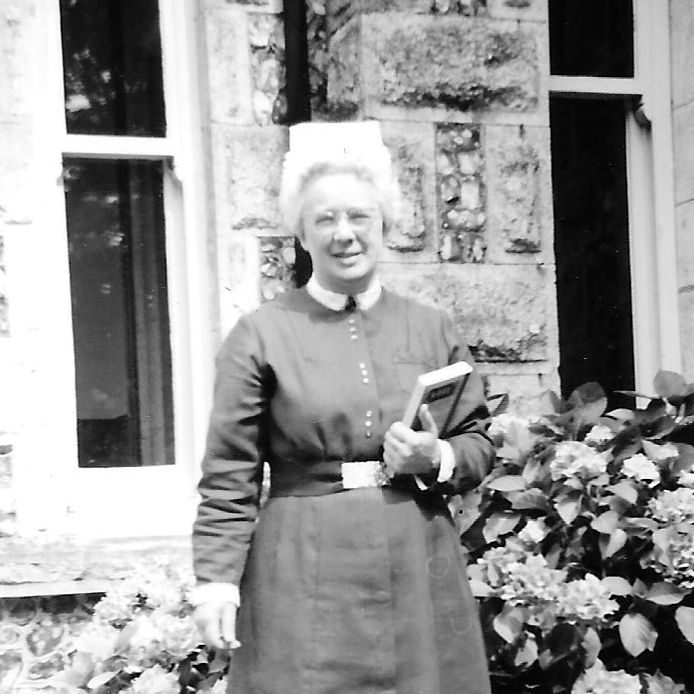
Born in 1870, Elizabeth Braithwaite’s career as a nurse and midwife in Emsworth is known to us because she was included in the list of Emsworth business people published by Kelly’s Trade Directory.
Elizabeth worked in Emsworth until the early 1930s and was probably Doris Griffiths predecessor. She died in 1960.
Edwina Bristow

Edwina Bristow was born in 1913 and trained to be a midwife in Essex.
Edwina was best known to several generations of schoolchildren as their school Nit Nurse. She died in 1995.
Nit nurses used to be regular visitors to schools throughout the UK. They came into school solely to check the children to see if they had head lice.
Nit nurses have disappeared: shrinking health authority budgets in the ‘80s made it hard to justify what could be an embarrassing and humiliating process.
“We’re strongest when we cheer each other on.” – Serena Williams
Women’s Groups in Emsworth

Women’s groups are often linch pins for a community. Unfortunately, the museum’s archive contains information about just a few of the many women’s groups we know thrived in Emsworth during the twentieth century.
The Emsworth Branch of the Mothers’ Union collated members’ memories in 2002. Members frequently spoke about one senior member,
Dorothy Horton
During the Second World War, because the Mothers’ Union was one of only a few active women’s groups it was very popular, with over 120 active members in the Emsworth Branch by 1948. Members recalled that it was all very formal, with new members receiving training.
In 1950 Dorothy became the Presiding Deanery Member of the Emsworth MU. Members remembered the group had a very distinct class culture: the ‘gentry’, which included Dorothy Horton, who was a Naval officer’s wife, and ‘everyone else’. The young wives who joined the MU were in awe of Dorothy. At her funeral, Rev David Partridge recalled that he had to be inspected by Dorothy when he first came to the Parish!
Around 1957, Dorothy set up The Cradle Club for young mothers. This was non-denominational and not affiliated to the MU. At one point it had around 60 members. It later changed its name to the St James Young Wives’ Group.
Mary Soames
Mary Strahan was born in London in 1884. She married Ralph Soames, a medical practitioner, in 1912.
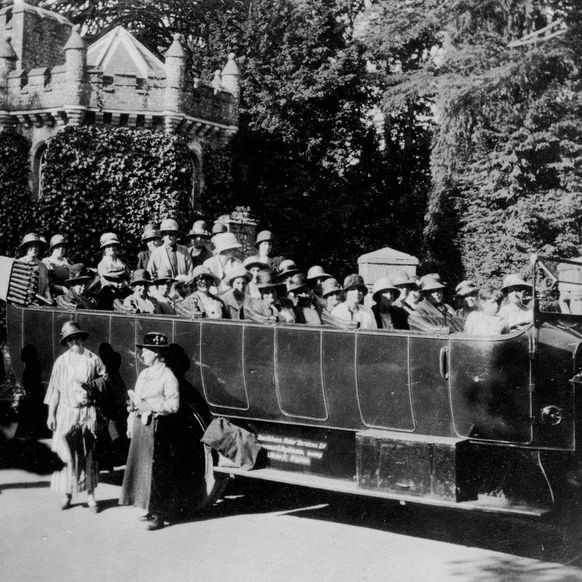
In the early 1930s Mary was responsible for producing some ambitious theatrical productions, including The Warblington Pageant, an outdoor dramatic retelling of the story of Warblington with a cast of around 100 amateur actors, all in period costume. She also produced theatrical productions for the pupils at Emsworth House and Stanmore Schools. She died in 1970.
In the 1930s, a GP’s wife was actively involved in his work. GPs often ran their practices from the family home and were on call all day, every day.


A wife would take telephone calls, receive samples, deal with patients at the door, and manage their husband’s working day (and night).
Thelma Parham
Thelma Prior was born in 1924 in Emsworth. She was evacuated to Chichester during the Second World War and returned to Emsworth after marrying Gordon Parham, whose family ran a boatyard in Dolphin Quay.
Thelma became an RNLI volunteer in 1973 and it was to become her second family. Her commitment to the organisation was recognised by the RNLI: she received several awards for her committment to the organisation.
As a volunteer, then committee member and eventually as President of the Emsworth Branch, Thelma was involved in fundraising for many years.
As a friend of local resident Margaret Foster, she knew that Margaret planned to leave money in her will to the RNLI. In 1996 Margaret left £1.4 million to the RNLI and Thelma, aware that she had wanted it to be used to purchase a lifeboat, made it her mission to see that the money was spent as her friend had wanted.

Thelma’s involvement with the Emsworth Branch of the RNLI continued until about four years before her death in 2014.
The MARGARET FOSTER visited Emsworth in 1998 on its way to enter service at Kirkwall. Thelma appeared in several newspaper stories about it.

Thelma discovered that Kirkwall, in Orkney, needed a new lifeboat and she made sure that the Margaret Foster Bequest was used to purchase it. Fittingly, this Severn class all-weather lifeboat was named the MARGARET FOSTER.